Light Received / The Boundary: Where Two Meet
What a boundary does to light
Inside one clear thing, such as air, or water, or glass, a ray of light simply goes on. Nothing happens to it. Everything of interest happens where one thing ends and another begins.
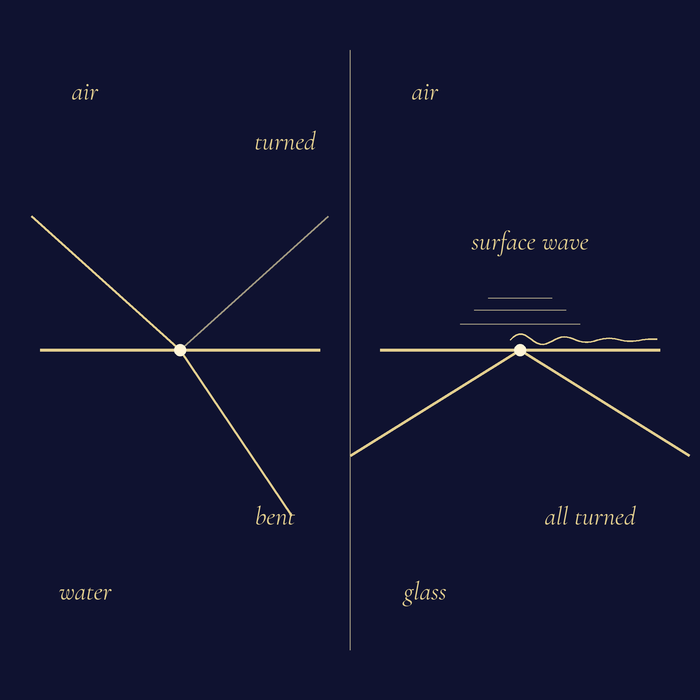
At that line, one ray becomes two. Part turns back, and that is reflection. Part goes on, bent, and that is refraction. Ibn Sahl in Baghdad wrote the law of the bending in 984, and it was found again in Europe six centuries later. Augustin Fresnel, in the 1820s, gave the rule for how much goes each way.
Neither the turned ray nor the bent ray exists anywhere inside the air or inside the water. They are made by the boundary and by nothing else. In optics, the reflection's sentence is simply the law.
Five things only a boundary can make
The rainbow. A raindrop is a boundary met three times: light bends on the way in, turns at the back, and bends again on the way out, and the colours part. Around 1300, Theodoric of Freiberg in Germany and Kamal al-Din al-Farisi in Persia worked this out independently, each with a glass globe of water. There is no rainbow in the air and none in the water. It lives where they meet.
Glare with a direction. Light turned back from water or a road comes off with its vibration lined up one way. The boundary gives the light an order it did not have. That is why polarising sunglasses can remove it.
The colours of a soap bubble. A film has two surfaces. Light turned from the front meets light turned from the back, and the two make colour by the interference of Pass 7. Two boundaries, a hair apart, make a third thing that neither makes alone.
The wave that lives on the edge. When light inside glass strikes the surface too steeply to escape, all of it turns back. Yet a faint presence of the light reaches a little way beyond the glass, clinging to the surface and fading within a wavelength. Newton noticed its effect. It belongs to neither side. It exists only at the boundary, and whole families of modern instruments are built on it.
The wave that is half light and half matter. At the boundary between a metal and glass, light can join with the metal's free electrons into a single travelling wave that is neither light nor electric current but both at once. It was predicted in 1957. Roman glassmakers had used a close cousin of it without knowing: the Lycurgus Cup, of the fourth century, is green when lit from the front and red when lit from within, because of gold and silver specks too small to see. In each speck, light and the metal's electrons swing together, held in place and not travelling. The ruby reds of medieval windows, such as those of Chartres, are cousins of the same kind, made mostly with specks of copper. Here the reflection is exact to the letter. Two meet at a boundary, and a third thing is produced that is neither of them.
Life does its light-work at boundaries
Go back through this study with that in mind.
The waiting molecule that becomes vitamin D sits in a membrane. The chlorophyll of Turning 1 sits in a membrane. The wheel that makes the cell's fuel in Turning 4 turns in a membrane, and is driven by a difference between the two sides. The retinal of the eye sits in stacked membranes at the back of the retina. The coral's partnership is one cell living inside the boundary of another.
A membrane is a boundary two molecules thick. Every great conversion of light that life performs happens in one. Life did not put its light-catchers in the middle of things. It put them at the edges, and then it made more edges: a single leaf cell holds folded membrane enough to cover many times its own surface.
The physicist Herbert Kroemer, receiving the Nobel Prize in 2000 for the layered materials inside every laser pointer and mobile phone, put the same finding in five words: "the interface is the device."
The reflection weighed
"When two meet at a boundary, a third is produced."
In optics it is established, and exactly. The turned ray, the bent ray, the rainbow, the surface wave: all are made by boundaries and exist nowhere else.
In the chemistry of surfaces it is established. The meeting-place of two materials has properties that neither has within.
In living things it is established as a pattern. The conversions happen in membranes.
As a law of everything it is symbolic, and three honest limits belong with it.
- The third is not always a gain. Sunburn is also a third thing made at a boundary. So is the fading of a painting.
- Often the third is only warmth. Most meetings of light and surface make nothing more particular.
- The boundary must hold. A third is made only while the two stay two. When a membrane is torn, the difference across it is lost and the wheel stops. Where the two simply mix, there is no boundary and nothing new.
That last limit is the Codex principle arriving by another road. Two that stay whole make a third was a statement about people in One Breath, Read Whole. Chapter 13 finds it in the partnerships of light. Here it is found in the plainest physics there is: keep the edge, and there is a rainbow; lose the edge, and there is only wet air.
The vesica, once more
The first reflection named the vesica, the almond where two circles overlap, as light's meeting-shape, and Pass 9 found it in the lens. This Part gives it a second and deeper reading. The vesica is the picture of a boundary that has width. It is not the line where one thing stops. It is the region that belongs to both and is neither, and it is where the third appears.
| Claim or reading | Grade | What the evidence shows |
|---|---|---|
| At a boundary one ray becomes two | established | The laws of reflection and refraction |
| The rainbow exists only where air and water meet | established | Worked out about 1300 |
| A wave can live on a boundary and on neither side | established | The basis of many instruments |
| Light and electrons can merge at a metal's surface | established | Predicted 1957; a close cousin colours Roman glass |
| Life's conversions of light happen in membranes | established | Skin, leaf, eye, cell |
| Light frees water from its surface without heat | contested | Reported 2023 and 2024; not yet settled |
| Wherever two meet, a third is produced | symbolic, with exact cases | True where the two stay two |
| The third is always good | not supported | Sunburn is a third |
Near-truths
- Nothing happens to light in the middle of anything. Everything happens at the edge.
- A boundary is not where two things end. It is where a third begins.
- The skin is not the wall of the self. It is the place where the self and the Sun make something together.
Stand by still water in daylight, or hold a glass of water at a window.
See three things: the sky turned back from the surface, the bottom seen bent through it, and the bright line of the surface itself.
None of the three is in the air. None is in the water.
Breathe gently, and never force or hold the breath.
Ask: at what edge in my life is a third thing waiting to be made? Rest.