Light Seen / Pass 3
The third pass falls under the Vector Moon, in Shema, the pause. Its sign is the triangle, the first stable form.
The light
Because light keeps to straight lines, it can be used to measure. The first science done with light was done with shadows, and its figure was the triangle.
The place
It is told of Thales of Miletus, about 600 BC, that he measured the height of a pyramid at Giza by waiting until his own shadow was as long as he was tall, and then pacing out the pyramid's shadow. The story is late and cannot be checked. What is certain is that about 240 BC Eratosthenes, librarian at Alexandria, used the same reasoning on the whole Earth. At noon on midsummer day the Sun shone straight down a well at Syene, while at Alexandria a pillar cast a short shadow. From the angle of that shadow and the distance between the cities he worked out the size of the globe, and came close.
What is known
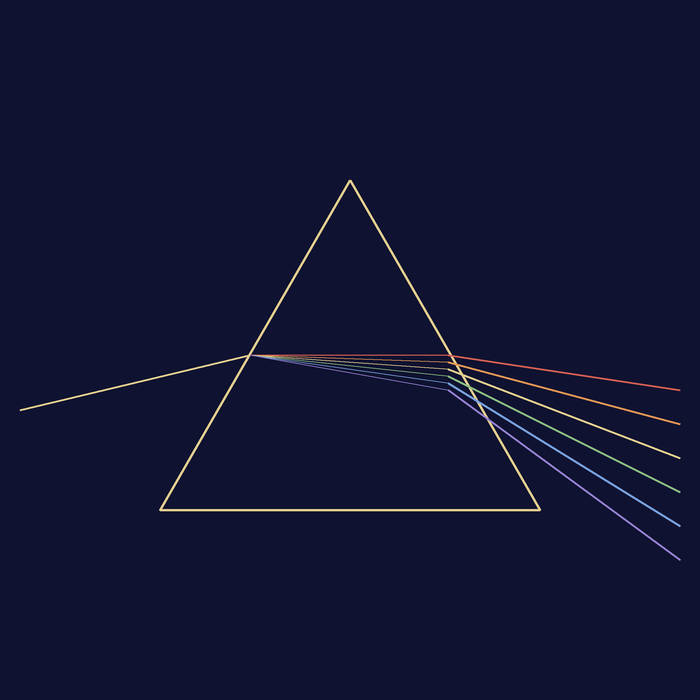
In 1666 Isaac Newton let a beam of sunlight through a hole in his shutter and onto a glass prism. The white beam opened into a band of colours. He then passed one colour through a second prism and found that it stayed the same. White light, he concluded, is not pure. It is every colour together, and the prism only sorts them.
The rainbow is the same sorting done by drops of rain. Each drop bends the sunlight, reflects it once inside, and bends it again. The light comes back most strongly at an angle of about forty-two degrees from the point opposite the Sun. Theodoric of Freiberg and Kamal al-Din al-Farisi each worked this out, independently, a little after 1300, using glass globes filled with water. René Descartes gave the calculation in 1637.
What is seen
A shadow on the ground. A band of colours on a wall. An arch after rain.
What is unseen
The colours were in the white light all along. And the rainbow is not in the sky. It is a set of directions from one eye. Two people side by side see two different bows, made by different drops.
The geometry beneath
The triangle twice. First the triangle of shadow, pole and ray, by which a shadow measures a height or a planet. Then the triangle of glass, by which white light is opened. And the rainbow is a circle: the edge of a cone of forty-two degrees whose tip is the eye. From the ground we see half of it. From an aircraft it can be seen whole.
| Claim or reading | Grade | What the evidence shows |
|---|---|---|
| Eratosthenes measured the Earth by shadows | established | Reported by later Greek writers; the method is sound |
| Thales measured a pyramid by its shadow | contested | The sources are centuries later |
| White light is a mixture of all colours | established | Newton's prism experiments, 1666 to 1672 |
| The rainbow forms at about forty-two degrees | established | Theodoric, al-Farisi, Descartes |
| Each person sees their own rainbow | established | Follows from the geometry |
| The triangle is the pause in which light is divided | symbolic | The reading of this study |
Near-truths
- Light did not need to be understood to be used. A stick and its shadow measured the world.
- White is not the absence of colour. It is all of them, unsorted.
- The rainbow is real, and it is nowhere. It exists only as a relation between the Sun, the rain and one who looks.
On a sunny day, stand a pencil upright on a sheet of paper outdoors.
Mark the tip of its shadow. Do not look at the Sun.
Let five easy breaths pass, and mark the tip again.
The small gap between the marks is the Earth turning.
Rest, and breathe normally.