Light Seen / Pass 4
The fourth pass falls under the Mirror Moon, in Shema. Its sign is the square: the first structure, the frame, the room.
The light
The reflection says that the Moon does not make light, it mirrors, and that light returned is breath remembered. The first half is plain fact and was known in antiquity. Anaxagoras taught it in Athens about 450 BC, and his teaching about the heavens brought a charge of impiety against him.
The place
The place of this pass is the Moon itself. It is a dark world. It sends back only about twelve parts in a hundred of the sunlight that falls on it, about as much as worn asphalt. It looks brilliant only because the sky behind it is black.
What is known
When the Moon is a thin crescent, the rest of its disc can often be seen glowing faintly. Leonardo da Vinci explained this about 1510. It is sunlight that has struck the Earth, bounced to the Moon, and bounced back to the eye. It is called earthshine, and it is light returned twice.
In July 1969 the astronauts of Apollo 11 left a tray of small corner mirrors on the Moon's surface. Later missions left more. Observatories on Earth still fire laser pulses at them and time the faint return, which takes about two and a half seconds for the round trip. From those returns we know the Moon's distance to within a fraction of an inch, and we know that it is moving away from us by about an inch and a half a year.
The oldest made mirrors known are discs of polished obsidian from Çatalhöyük in Turkey, about eight thousand years old.
What is seen
A bright disc that keeps time: waxing, full, waning, gone, in about twenty-nine and a half days.
What is unseen
That moonlight is sunlight, a little over a second old on its last leg. That the "dark" part of a crescent is lit by us. And that the plainest way we have of knowing where the Moon is, is to send it light and wait for the light to come back.
The geometry beneath
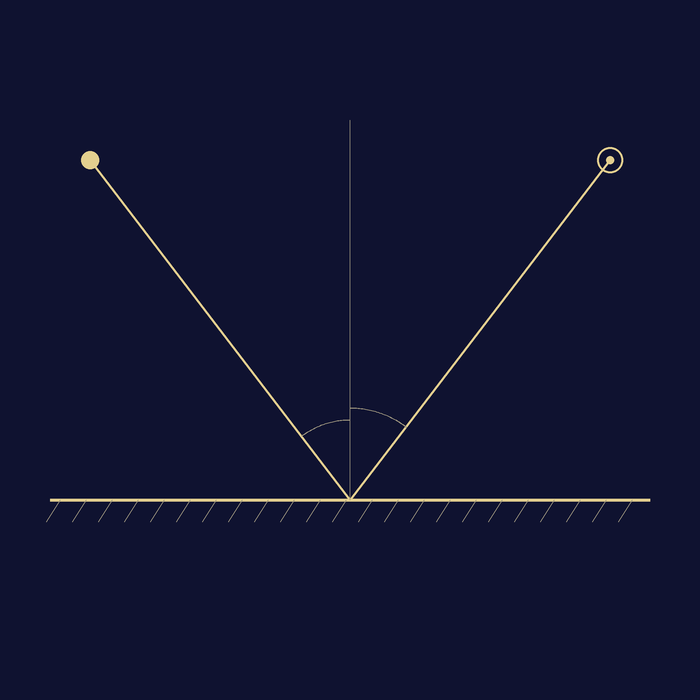
One rule: the angle at which light arrives equals the angle at which it leaves. Hero of Alexandria showed in the first century that this is also the shortest path from the source to the eye by way of the mirror. A corner mirror, three flat faces set square to one another like the inside corner of a box, sends any ray back exactly the way it came. The square of this Moon is that corner.
| Claim or reading | Grade | What the evidence shows |
|---|---|---|
| The Moon shines by reflected sunlight | established | Known since antiquity; phases and eclipses |
| The Moon reflects about 12 percent of the light it receives | established | Measured |
| Earthshine is sunlight reflected from Earth to Moon and back | established | Leonardo, about 1510; modern measurement |
| Returned laser light measures the Moon's distance and drift | established | Lunar laser ranging since 1969 |
| Reflection is a kind of memory | symbolic | A mirror keeps nothing; the image is new each instant |
| Light returned is breath remembered | symbolic | The reading of this study |
Near-truths
- A mirror does not remember. It returns. The remembering is done by the one who receives the return and compares it with what was sent.
- The Moon is one of the darkest bodies we know by sight, and it has lit the nights of every human who ever lived.
- We learn the Moon's distance by the same act the Codex calls reflection: we send, we wait, and we attend to what comes back.
On a night when the Moon is up, stand where you can see it.
Let the breath be easy. On each out-breath, look. On each in-breath, soften the eyes.
Remember once, without effort, that this is sunlight, and that the Sun is under your feet.
Stay for seven breaths.
Rest, and breathe normally.