Light Seen / Pass 5
The fifth pass falls under the Stillness Moon, in Vara, the exhale. Its sign is the cross: four directions and a centre.
The light
Under the Moon of stillness stands the one thing in physics that does not change: the speed of light.
The place
At Abu Simbel in southern Egypt, about 1260 BC, the builders of Ramesses II cut a temple nearly two hundred feet into a cliff. Twice a year, in February and in October, the rising Sun shines down the whole length of the temple and lights the seated statues in the innermost room. It lights three of the four. The fourth is Ptah, a god linked with the earth and the dark, and he stays in shadow. In the 1960s the whole temple was cut into blocks and moved to higher ground, away from the rising lake. The event now falls about a day later than it did.
What is known
For most of history it was not known whether light takes any time to travel. In 1676 the Danish astronomer Ole Rømer found that the eclipses of Jupiter's moons ran late when Jupiter was far from the Earth and early when it was near. The delay was the time the light took to cross the extra distance.
Maxwell's equations of 1865 gave light a fixed speed with no mention of who was measuring it. Einstein took that seriously in 1905. If the speed of light is the same for everyone, then time and length cannot be. Clocks in motion run slow and moving rulers shorten, by exactly the amounts needed to keep that one speed the same for all. This has been tested many times and is used daily; satellite navigation would fail without it.
It is often said that for light itself no time passes. The mathematics does give zero for the time elapsed along a light ray. Physicists are careful here, because a ray of light is not a traveller with a clock, and the statement is better taken as a manner of speaking than as a report.
Light can also be slowed. In 1999 Lene Hau and her colleagues passed a pulse of light through a cloud of extremely cold atoms and slowed it to the pace of a bicycle. In 2001 they brought a pulse to a stop, held it in the atoms, and released it again.
What is seen
A beam reaching the back of a dark temple on two mornings of the year.
What is unseen
That the stillest thing in nature is also the fastest. Everything else in physics is measured against it.
The geometry beneath
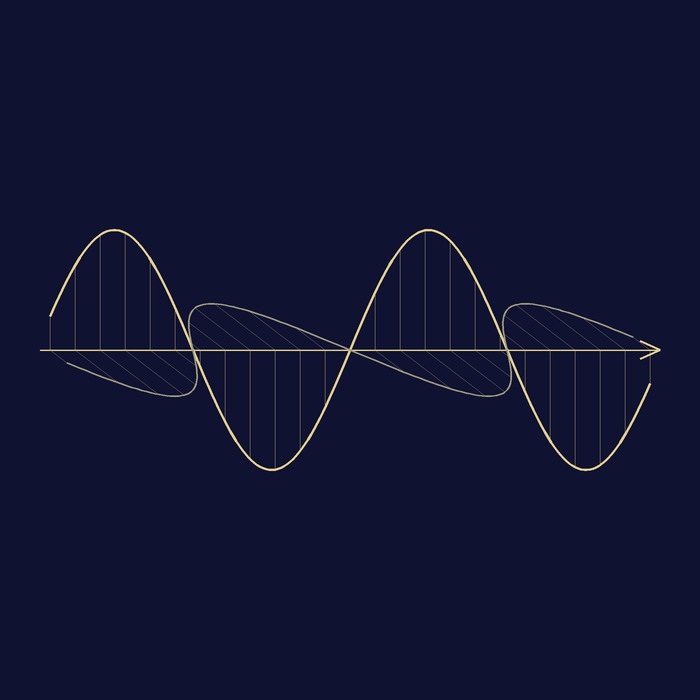
The cross of this Moon is exact. In a light wave the electric force and the magnetic force are at right angles to each other, and both are at right angles to the direction in which the wave travels. Three lines, mutually square, meeting at a point. Each force gives rise to the other as it changes, and that is how light carries itself across empty space with nothing to carry it.
| Claim or reading | Grade | What the evidence shows |
|---|---|---|
| Light has a finite speed | established | Rømer, 1676; every measurement since |
| That speed is the same for all observers | established | Relativity, tested for over a century |
| For light, no time passes | a manner of speaking | The mathematics gives zero; a ray keeps no clock |
| Light can be slowed and stopped in matter | established | Hau and others, 1999 and 2001 |
| The Sun lights the sanctuary of Abu Simbel twice a year | established | Observed; shifted about a day by the move |
| The speed of light is the still centre of the world | symbolic | The reading of this study |
Near-truths
- The Codex names a still centre that all things turn about. Physics has one too, and it is not a place. It is a speed.
- A pulse of light was stored as an imprint in a cloud of atoms and then let go, with its shape intact. That is closer to "breath held and released" than anything the reflection claimed, and it was done on a table in Massachusetts.
- At Abu Simbel the builders let the light reach the centre and left one figure dark. They knew the stillness needs a shadow.
Sit comfortably. Let the breath go out, slowly and fully, without pushing.
At the end of the out-breath there is a moment before the next breath begins.
Do not hold it. Only notice it.
Do this for five breaths.
Rest, and breathe normally.