Light Seen / Pass 9
The ninth pass falls under the Echo Moon, the first of the five Moons of the Monad. In the Codex its sign is the vesica: the centre repeated, and the almond where two circles meet.
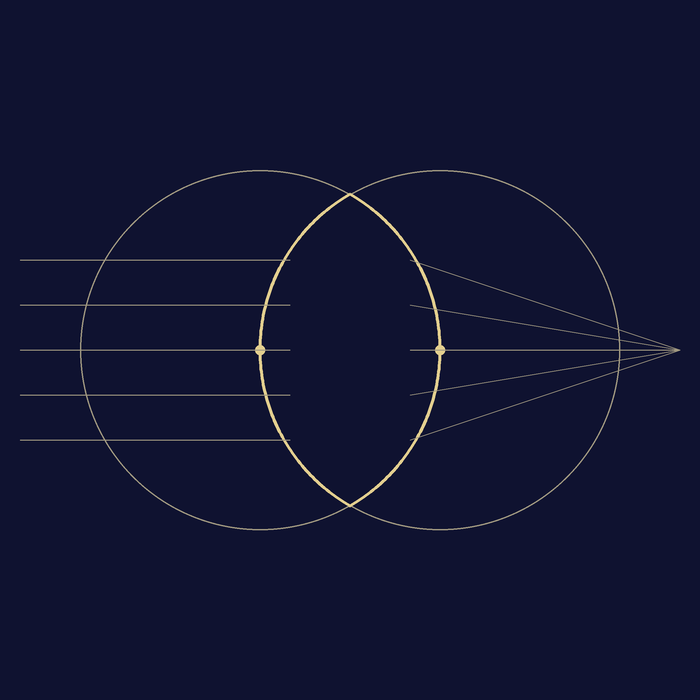
The light
The reflection says the vesica is the light-bearing field. Pass 7 found one true sense of that in the overlap of waves. This pass finds a second, and it is in every eye.
The place
About 1140 Abbot Suger rebuilt the choir of his abbey church at Saint-Denis, near Paris, with walls opened into great windows of coloured glass. He wrote that the church shone with a new light, and that the mind is led by material lights toward the true light. He drew on an old theology in which all things are a descent of light from its source. The style that began there is called Gothic. At Chartres, rebuilt after a fire in 1194, much of the original glass is still in place. On the summer solstice, about midday, a spot of clear light from one window falls on a metal stud set into the floor.
What is known
A lens is a piece of glass, thicker in the middle, that bends light inward to a point. Its simplest form, curved the same on both sides, has in section exactly the almond shape made by two overlapping circles. A lens is a vesica in glass.
The eye has one. In 1604 Johannes Kepler showed that the lens of the eye casts a small, upside-down picture of the world onto the back of the eyeball. Six hundred years earlier Ibn al-Haytham had settled a still older question. The Greeks had mostly held that sight goes out from the eye like a hand. He showed, by reasoning and experiment, that sight is light coming in.
The same thing can be done with no lens at all. A small hole in the wall of a dark room throws an upside-down picture of the outside onto the opposite wall. The Chinese thinker Mozi described it about 400 BC. It is the ancestor of the camera, and the word camera means room.
What is seen
The world, right way up, in colour and depth.
What is unseen
That the picture is upside down on the back of the eye, and that there is a blind spot in each eye that the mind paints over. Seeing is partly made.
The geometry beneath
The vesica piscis, as the first proposition of Euclid's Elements draws it: two equal circles, each passing through the centre of the other. Euclid used it to build the equilateral triangle. The glass grinder uses it to gather light. The masons of the cathedrals used it for the pointed arch and for the frame around holy figures. It is a figure in which two equal things overlap and something is focused between them.
| Claim or reading | Grade | What the evidence shows |
|---|---|---|
| A simple lens has the cross-section of a vesica | established | Geometry of a biconvex lens |
| The eye forms an inverted image on the retina | established | Kepler, 1604 |
| Sight is light entering the eye | established | Ibn al-Haytham, about 1011 to 1021 |
| A pinhole in a dark room forms an image | established | Described by Mozi, about 400 BC |
| Gothic builders held a theology of light | established | Suger's own writings |
| A beam marks the floor at Chartres at midsummer | established as an event | The date of the device is uncertain |
| The vesica is the light-bearing field | symbolic | It bears pattern in Pass 7 and focus here |
Near-truths
- The vesica does not make light. It gathers it. That is what the reflection's phrase can honestly mean.
- Every act of seeing passes through an almond of clear tissue a third of an inch across.
- Abbot Suger and Ibn al-Haytham would not have agreed on what light is for. They agreed that it comes in, and that a building or an eye must be shaped to receive it.
Sit facing a window in daylight. Do not face the Sun.
Close your eyes and let three easy breaths pass. Notice the glow through the lids.
Open your eyes slowly on an in-breath, and let the room arrive.
Know that it has arrived upside down, and that you have turned it without trying.
Rest, and breathe normally.