Light Seen / Pass 11
The eleventh pass falls under the Descent Moon. Its sign is the star.
The light
The reflection says each star is a breath node, exhaling light across time and space. This is a symbolic reading. But some stars do something for which "breathing" is the astronomers' own word.
The place
For the ancient Egyptians the year turned on one star. Sirius, the brightest in the sky, vanishes for about seventy days each year in the glare of the Sun. Its first reappearance at dawn, in high summer, came just before the Nile began to rise. They called the star Sopdet, and its return opened the year.
Half a world away the navigators of the Pacific crossed thousands of miles of open sea by the stars, without instruments. A star rises at the same point on the horizon all year. A trained navigator held in memory the rising and setting points of scores of stars, and steered by each in turn as it climbed. That art was nearly lost and has been revived in living memory.
What is known
A star is a ball of gas so massive that its own weight heats and squeezes its centre until atomic nuclei fuse. In the Sun, hydrogen is fused to helium, and about four million tonnes of matter become energy every second. That energy begins as light deep in the core. It cannot fly straight out. It is absorbed and sent out again in a random direction, countless times, and estimates of the time it takes to work its way to the surface run from many thousands to more than a hundred thousand years. From the surface it reaches the Earth in eight minutes and twenty seconds.
The heavier elements are made in stars and scattered when stars die. The carbon in a body, the oxygen in a breath and the iron in the blood were made that way. This was set out in a famous paper of 1957 and is established.
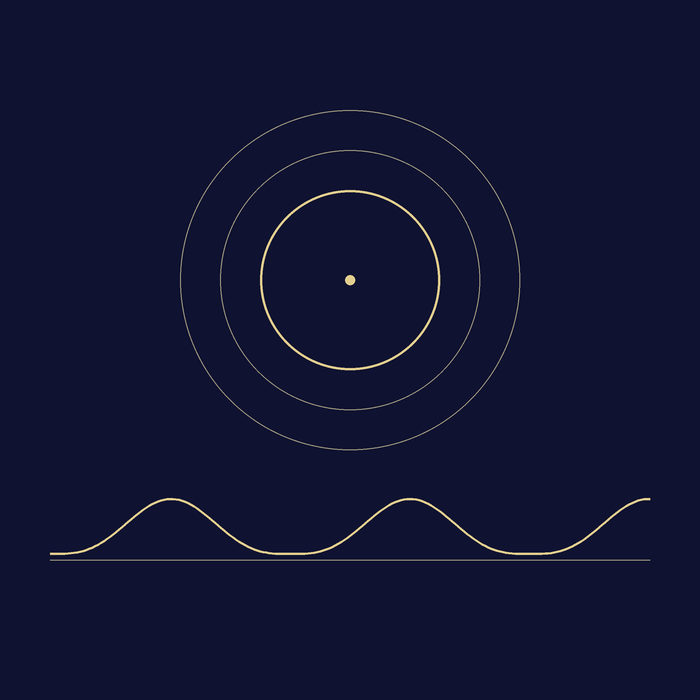
And some stars pulse. A class called Cepheid variables swell and shrink in a regular rhythm of days, growing brighter and dimmer as they do. In 1912 Henrietta Swan Leavitt, working at Harvard, found that the longer a Cepheid's period, the greater its true brightness. That gave astronomers a way to measure distances across space. With it, Edwin Hubble showed in the 1920s that there are other galaxies and that the universe is growing. The Sun also trembles, more gently, with a main rhythm of about five minutes.
What is seen
A point of light that twinkles. The twinkling is not in the star. It is our own air, moving.
What is unseen
The age of the light within the Sun. The pulse of the Cepheids, too slow for a glance. And the fact that we are made of what stars gave out.
The geometry beneath
The sphere, held between two forces: gravity pulling in and pressure pushing out. Where they balance, the star is steady. Where they overshoot each other in turn, the star pulses. The five-pointed star we draw is not in the sky. It is made by the eye and by the lens, which spread a bright point into rays.
| Claim or reading | Grade | What the evidence shows |
|---|---|---|
| Stars shine by fusion | established | Twentieth-century physics |
| Sunlight reaches the Earth in about 8 minutes 20 seconds | established | Measured |
| Energy takes many thousands of years to leave the Sun's core | established in outline; the figure is an estimate | Models of the solar interior |
| The elements of life were made in stars | established | Burbidge, Burbidge, Fowler and Hoyle, 1957 |
| Some stars pulse in a regular rhythm | established | Cepheid variables; Leavitt, 1912 |
| The dawn rising of Sirius opened the Egyptian year | established | Egyptian calendars and texts |
| Each star is a breath node, exhaling light | symbolic | The reading of the reflection |
Near-truths
- A star does not breathe as we do. But a pulsing star swells and settles in a steady rhythm, and that rhythm gave us the size of the universe.
- The sunlight on your hand is eight minutes old on its last journey and ancient on its first.
- The star-path navigators did not carry a map. They carried the sky in memory, and it was enough.
Sit quietly and rest a hand on your chest.
On the in-breath, remember that the oxygen entering was made in a star.
On the out-breath, remember that the carbon leaving was made in a star.
No more than that, for seven easy breaths.
Rest, and breathe normally.