Light Received / Every Surface: What Absorbed Light Becomes
The rule
When light meets a surface, three things can happen and no others. It is turned back, it passes through, or it is taken in. The three always add up to the whole.
What is taken in never vanishes. This is the oldest law in physics applied to the newest question. Absorbed light must become something. The question the reflection asks is: what?
There are seven answers.
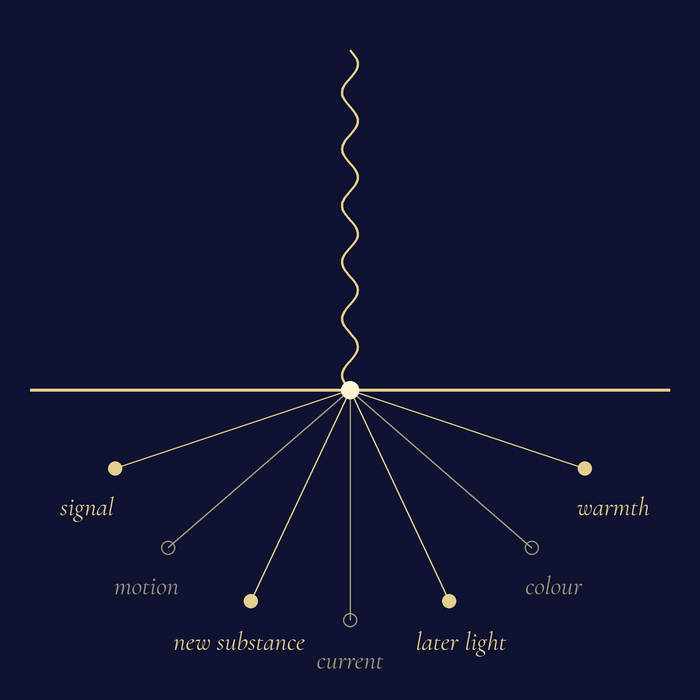
1. Warmth
Most light that is absorbed, by most surfaces, becomes heat. The stone warm at evening is the plainest case. It is also the largest. The Earth turns back about three parts in ten of the sunlight that reaches it and takes in the rest, and what it takes in it gives out again as a glow of invisible infrared. The balance between those two is the whole of the planet's temperature. Ice turns back most of its light, and dark sea takes most in, which is why the loss of ice warms the world further.
Heat is the least particular third. Any surface can make it. It is what happens when a surface receives light and has nothing more exact to do with it.
2. Colour
Colour is the light a surface declines. A leaf takes in red and blue and turns back green, so the green we love in a forest is the part of sunlight the forest did not use. Colour is therefore a third thing in a precise sense. It is not in the white light and it is not in the leaf in the dark. It appears only at the meeting.
Some surfaces make colour with no pigment at all, by their fine structure alone: the wing of the blue morpho butterfly, the neck of a pigeon, the inside of a shell. Here even the taking-in is not needed. Shape alone, at the scale of the light's own wave, sorts the colours.
3. Later light
Some surfaces take light in and give light back, changed: a longer wave, a moment or an hour afterwards. Corals do this, and minerals under an ultraviolet lamp, and the pale glow of a watch dial. Pass 8 met living light. This is its plainer cousin, light returned at a lower pitch.
4. Current
At the surface of certain materials, a photon frees an electron, and the electron can be led away as an electric current. Edmond Becquerel saw it in 1839. Einstein explained it in 1905. The first practical solar cell was made in 1954. Turning 1 found the same act in the leaf.
5. New substance
Light can make and unmake molecules. Vitamin D in the skin is one case, and sugar in the leaf is the greatest. There are others, each a world:
- High in the air, ultraviolet splits oxygen, and the pieces join into ozone, which then absorbs the very ultraviolet that made it. The sky grows its own skin, by the same light it shields us from.
- On light-sensitive coatings, and from the 1830s on silver salts, light leaves a mark that can be kept: photography, from the 1820s. For a century and a half every photograph was a surface chemically changed by the light of the thing it shows.
- On certain minerals, light splits water into hydrogen and oxygen with no living thing involved. This was first shown in 1972, and it is the root of the present work on fuel made from sunlight.
- Light fades cloth, yellows paper and ages paint. The same power that builds also takes apart.
6. Motion
Light pushes. The push is very small and entirely real. It was measured in 1900, it is why a comet's dust tail streams away from the Sun, and in 2010 a spacecraft crossed toward Venus driven by nothing but sunlight on a thin sail.
7. Signal
Last and most refined, a surface can take in light and make meaning of it. The eye does this, and the skin, as the last chapter showed. Plants do it too. A seed under soil can tell red light from far-red, and so knows whether it lies in open ground or under the shade of other leaves. Here the third thing is neither heat nor substance. It is news.
One more, still being weighed
In 2023 and 2024 a group at the Massachusetts Institute of Technology reported that visible light, striking the surface where water meets air, can knock clusters of water molecules loose directly, without first heating the water. They named it the photomolecular effect, and found it strongest for green light. If it holds, it bears on clouds, fog and the sea. Other groups have questioned the measurements behind such claims, and it has not been independently settled. The grade is contested. It is told here because of where it happens: only at the boundary.
What the seven have in common
| Fate | The surface | The third thing |
|---|---|---|
| Warmth | Any | Heat |
| Colour | Leaf, wing, paint | The light that was declined |
| Later light | Coral, mineral | A slower glow |
| Current | Solar cell, leaf | Moving charge |
| New substance | Skin, leaf, sky, film | A molecule that was not there |
| Motion | Sail, comet dust | A push |
| Signal | Eye, skin, seed | News |
Read the middle column. The light is the same in every row. What it becomes is decided by the surface. A rock and a leaf lie side by side in the same Sun, and one grows warm and the other grows.
This is the finding Chapter 16 will name, "Light is completed by what receives it," met here from below. It can now be said more exactly. The receiver does not only complete the light. The receiver chooses which of seven things the light will be.
Near-truths
- Nothing is merely lit. Everything that light touches is making something of it.
- Colour is the gift a thing gives back from what it could not use.
- Heat is what light becomes when nothing more particular receives it.
In daylight, find a stone, a leaf and your own hand.
Touch the stone. Its warmth is light, received.
Look at the leaf. Its green is light, declined, and inside it sugar is being made.
Look at your hand. Breathe gently, and never force or hold the breath.
One light, three surfaces, three answers. Rest.